

From the soft glow of dawn to the harsh glare of midday, our world may appear calm, serene, even beautiful. But beyond that visible surface lies a hidden reality — pollution in its many forms, flowing through the air, drifting in silence, or leaving scars on the land. What if we could peel back the veneer of the everyday and expose the unseen forces that shape our environment? What if light, shadow, and composition could reveal not just beauty — but danger, neglect, human cost?
Visual artists and environmental researchers are now doing exactly that. Through experimental photography and inventive techniques that merge science with storytelling, they are turning invisible pollution — particulate matter, industrial waste, acoustic disturbance — into powerful visual metaphors. Their images do more than document: they translate data into emotion, turning what we breathe and what we ignore into photographs we cannot ignore. In making the imperceptible perceptible, they challenge our complacency and invite us to see the world not only as it appears, but as it truly is under the surface.
The Unseen Made Visible
For many, pollution remains an abstract — a statistic on a government website or a data point on a public health chart. But what if pollution could be seen? What if the faint haze of particulate matter, the dull drone of industrial emissions, or the silent scars of human impact could be captured in a photograph, made tangible? Recent efforts in environmental photography — blending art and science — show that photography can render the invisible visible, turning toxic air, noise, and human disruption into compelling visual metaphors for deep social and ecological problems.
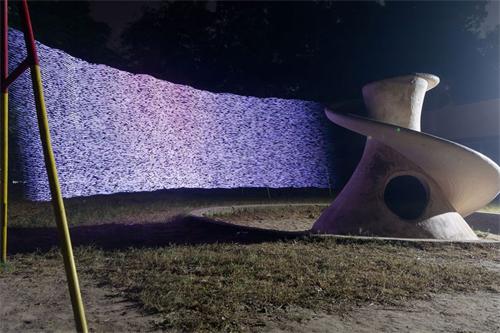
One striking example of this is the work of the Air of the Anthropocene project. By combining long exposure photography with real-time air pollution measurements, the collaborators translated invisible fine particulate matter (PM2.5) into glowing trails of light. In this “light painting” technique, a photographer carrying a portable sensor walks through a scene; the sensor measures the concentration of pollutants and triggers an array of LEDs to flash more rapidly as pollution increases. The camera’s long exposure then records these flashes as luminous streaks or dots — like ghostly brushstrokes across the landscape — visually mapping pollution that would otherwise remain unseen. [1]
These images — whether of a playground in urban Delhi, a biomass burning kitchen in Addis Ababa, or a factory-laced town in Wales — provide a haunting but accessible representation of air pollution. Where air might look deceptively clear, the light painting reveals hidden concentrations of harmful particles creeping through neighborhoods and everyday environments. [1]
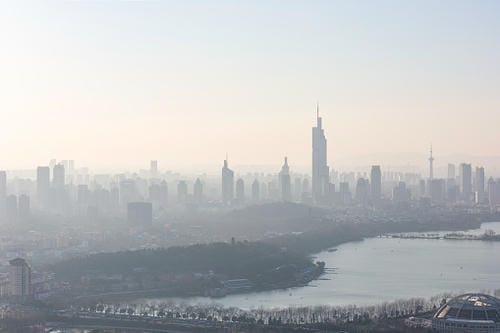
Beyond air pollution, photography has a long tradition of environmental documentation. Early efforts such as Documerica — commissioned by environmental authorities in the 1970s — used documentary photography to capture polluted rivers, smog, industrial waste, and the consequences of unregulated development across the United States. [2]
More recently, photographers such as J. Henry Fair have used aerial photography to document the environmental damage wrought by industrial activities: coal-ash disposal sites, oil spills, mountaintop mining scars, chemical waste ponds. These images cast stark, mosaic-like patterns across the land — visual evidence of human impact on the planet, and photographic metaphors for the way industrial societies extract and discard, often invisibly. [3]
In doing so, environmental photography transcends the role of simple documentation, becoming a form of activism. By making visible what is ordinarily hidden — pollution, degradation, damage — photographers can provoke a deeper awareness, and perhaps inspire change. As one commentator put it, photography in this mode creates a “visual argument … to inspire accountability.”
Sound and Silence, Human Noise as Landscape
While air pollution is often spatially expressed — smog across a skyline, industrial waste scarring the land — other forms of human impact are less about what you see, and more about what you hear (or don’t hear). Noise pollution, though invisible, shapes our environments in powerful ways. And photographers — or more broadly, environmental documentarians — are beginning to tackle that too.
There is growing scientific evidence that human-generated noise disrupts natural soundscapes — from pristine wilderness to suburban streets — altering ecosystems and harming wildlife that rely on sound for communication, hunting, or navigation. In many protected natural areas, studies have shown that anthropogenic noise has more than doubled the natural sound levels, degrading the serenity of wild places and affecting species that depend on acoustic cues for survival. [4]
Capturing noise visually is a challenge, but some experimental practices have emerged. For example, mixed media efforts combine photography with field recordings: static images — landscapes, urban scenes, communities — are paired with sound recordings of real noise pollution, giving viewers a multimedia sense of a place’s acoustic atmosphere.
In other cases, photographers use image-based data representation: street-view photos or community sourced imagery are annotated and mapped to show sources of noise pollution — busy highways, factory zones, nightlife districts — overlaying visual, geographical, and contextual data to depict how sound permeates spaces differently from day to night or from one neighborhood to another.[5]

These visual-acoustic hybrids act as metaphors: a quiet lake framed by dusk light may hint at peace, but with a subtle sonic overlay or data annotation, suddenly it becomes a site of disturbance — a fragile ecosystem under threat from human sounds that we might otherwise ignore.
Through such imagery and data driven art, noise pollution becomes more tangible: not only as a health hazard for humans (sleep disruption, stress, hearing loss) but as an environmental concern affecting biodiversity, migration, reproduction, and ecological balance.
By rendering sound visible — or at least representable — photography expands its ability to document human impact beyond the purely visual realm.
When Human Impact Becomes Metaphor?
What makes these photographic works so powerful is not just their technical ingenuity, but their ability to transform environmental harm — normally abstract, hidden, or denied — into a visual language that people can intuitively understand. Pollution becomes trails of light, toxic waste becomes alien landscapes, noise becomes a silent but present danger — all captured through the lens.
In this context, photography shifts from passive recording to active storytelling. It does not merely reflect the world — it reinterprets it, casting invisible threats into light and giving human impact a face. Photographs like those of Air of the Anthropocene or the industrial aerial shots of J. Henry Fair become metaphors: for consumption, neglect, environmental injustice, and collective responsibility.
In the process, these images foster empathy. By showing pollution not as distant, remote, or scientific but as present, local, and immediate, they challenge viewers to confront the consequences of modern life. They blur the boundaries between natural landscapes and human-shaped environments, reminding us that the two are deeply interwoven — and that our everyday decisions, infrastructures, and habits shape the world in visible and invisible ways.
Photographic works like these — born from a fusion of science, art, and activism — show that our perception of the environment can be expanded. Pollution need not remain hidden. Noise need not remain inaudible. The camera can become a microphone for silence, a brush for light, a witness for damage.
In doing so, photography reclaims a critical role: not only to document beauty, wilderness, and tranquility — but to reveal the cost of industrial modernity, to give form to what we so often ignore, and to open a space for awareness, reflection, and perhaps eventual change.
Sources:
[1]: https://www.birmingham.ac.uk/news/2024/painting-with-light-illuminates-photo-evidence-of-air-pollution
[2]: https://en.wikipedia.org/wiki/Documerica
[3]: https://www.lifescienceart.com/science/environmental-science/aerial-photography-exposes-devastating-impact-industrial-pollution
[4]: https://www.hcn.org/articles/wildlife-how-human-noise-pollution-is-disrupting-parks-and-wild-places
[5]: https://pmc.ncbi.nlm.nih.gov/articles/PMC12465645
References:
https://somaverge.apc.edu.ph/wp-content/uploads/2025/01/Farinas-Thesis-Journal-2025.pdf
https://health.oregonstate.edu/news-and-stories/2025-07/study-documents-unhealthy-noise-portland-provides-research-framework-other
Angles
How Strange Angles Are Rewriting Visual Storytelling in 2025?
In a world overflowing with images — social media feeds, digital portfolios, travel blogs, curated Instagram walls — photographers are increasingly turning to unusual, off-kilter, even disorienting angles.
Elevate
10 Pro Moves to Elevate Your Photography
Photography is more than pressing a button; it’s an act of seeing — of paying close attention to the world around you, and capturing not what things look like, but what they feel like.
Levitation
How to Create Dream-like Levitation Portraits Without Photoshop?
There’s something inherently magical about a photograph that appears to defy gravity — a person floating mid-air, hair and clothes drifting softly, and the world below slipping away.